how-to
Habit Stacking: 20 Examples and How to Track Them
Habit stacking attaches a new habit to an existing routine. Learn the formula, see 20 practical examples, and learn how to track a stack in an app.
The idea
Habit stacking, popularised by writer James Clear in Atomic Habits (and earlier by BJ Fogg's "anchor" idea), uses a simple formula:
After I [current habit], I will [new habit].
The existing habit is the cue. You do not need to remember or find motivation, because the cue appears by itself.
Rules for a good stack
- Make the anchor specific. "After I pour my morning coffee" beats "in the morning".
- Keep the new habit tiny. Two minutes or less to start.
- Same place, same order. Consistency builds the link.
- One stack at a time. Add the next only when the first feels automatic.
20 examples
Morning
- After I pour my coffee, I will review my top three tasks.
- After I brush my teeth, I will do ten squats.
- After I sit at my desk, I will open my planner before email.
- After I make my bed, I will drink a glass of water.
Work 5. After I finish a meeting, I will write down one next action. 6. After I close my laptop at 5, I will plan tomorrow's top three. 7. After I start a focus session, I will put my phone in another room. 8. After I send a big email, I will take a 5 minute walk.
Health 9. After I eat lunch, I will walk for ten minutes. 10. After I get home, I will change into workout clothes. 11. After I put on my pyjamas, I will stretch for two minutes. 12. After dinner, I will take my vitamins.
Learning 13. After I sit on the train, I will read two pages. 14. After I finish breakfast, I will do one language lesson. 15. After I open my laptop on Sunday, I will read my notes from the week.
Evening 16. After I put the kids to bed, I will write one line in a journal. 17. After I plug in my phone, I will set out tomorrow's clothes. 18. After I turn off the TV, I will read for ten minutes. 19. After I wash the dishes, I will tidy one surface. 20. After I get into bed, I will write one thing I am grateful for.
Tracking a stack
A stack works only if you notice when it breaks. Track it where you already look:
- Show habits next to your tasks so they are part of your morning view.
- Check off immediately. A late check-in is easy to forget.
- Watch streaks, but don't worship them. Missing a day is fine; missing twice is the thing to avoid.
In DonDon
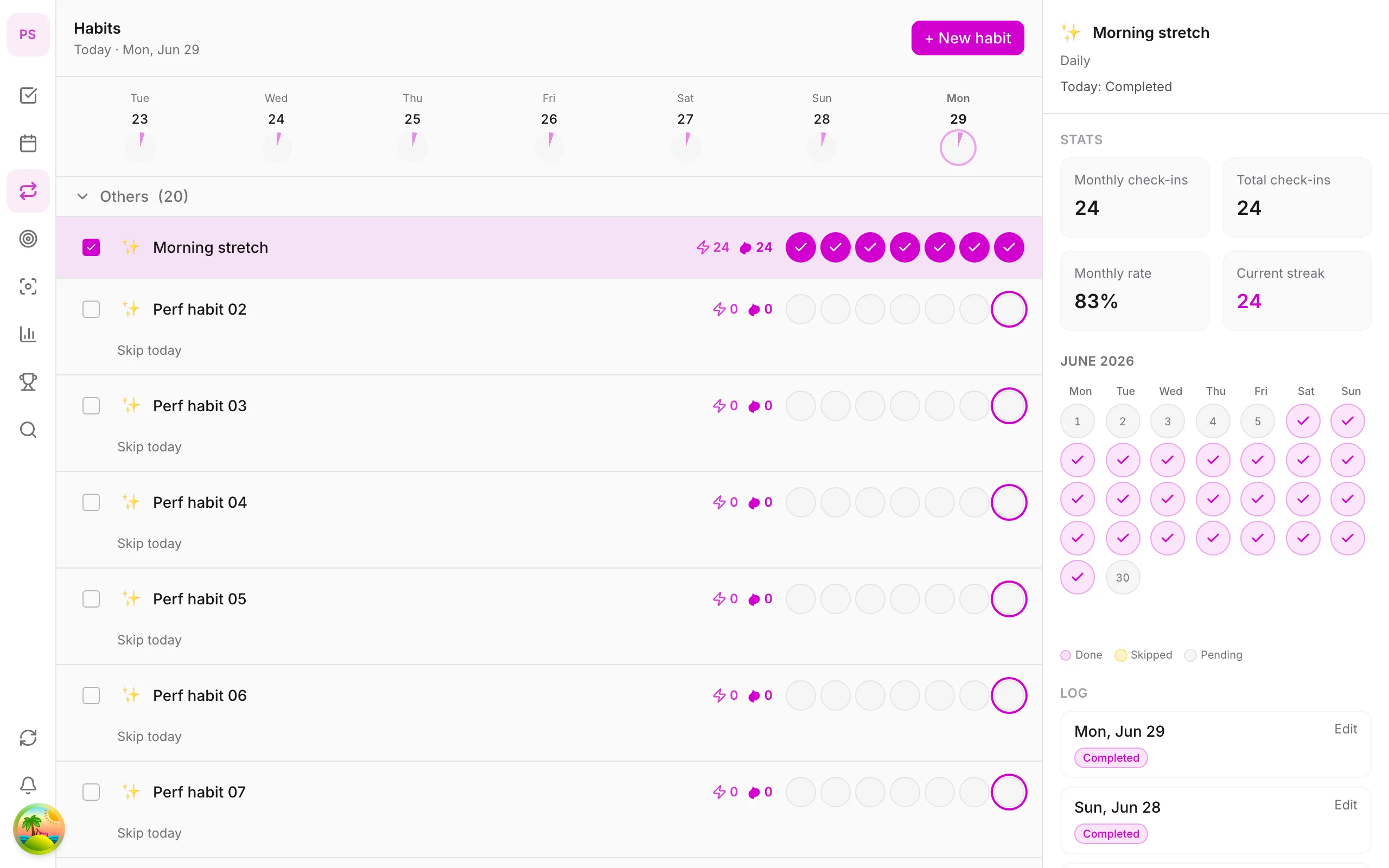
- Habits appear on the Today view beside your tasks.
- Each habit has a calendar heatmap to show streaks and gaps.
- Achievements add small rewards.
- On desktop, an optional companion pet (Premium) can remind you of pending habits; see desktop pet apps.
The Free plan includes one habit, enough to test a stack. Premium allows up to 50 and adds month and year goals so habits tie to larger goals. See the habit tracker guide and goals guide.
Designing your own stack
Examples help, but your stack should fit your life. Use this process.
Step 1: list your current routines. Write down what you already do every day without thinking: waking up, brushing teeth, making coffee, commuting, eating, closing the laptop, going to bed.
Step 2: choose the anchor. Pick one routine that is reliable and happens at a natural point for the new habit.
Step 3: choose a tiny new habit. Make it small enough to do on your worst day. One push-up, one line in a journal, one glass of water.
Step 4: write the sentence. "After I [anchor], I will [habit]." Say it aloud.
Step 5: place a physical cue. A book on the pillow, shoes by the door, a note on the kettle.
Step 6: track it. Check it off the moment you finish.
Expanding a stack safely
Once a habit is automatic (many people find this takes weeks), add a link:
After I pour my coffee, I will review my top three tasks. After I review my tasks, I will write the first line of my report.
Keep stacks to two or three links. A chain of eight habits breaks at the weakest link.
Troubleshooting
"I forget the new habit." Your anchor may not be reliable. Choose one you never skip, or add a visual cue.
"I do it for a few days and stop." The habit may be too big. Halve it, then halve it again.
"The anchor happens at inconvenient moments." Change the anchor, not the habit. Many routines vary day to day.
"I do the anchor but skip the habit." Reduce friction: prepare the next step the night before.
"It feels pointless." Connect it to something you care about, and review why in your weekly review.
Making it enjoyable
Habits stick when they are not unpleasant. You can:
- Pair the habit with something you like, such as music or a favourite drink.
- Track visibly, because seeing a streak is satisfying.
- Celebrate briefly. A small "done" moment helps the brain connect action and reward.
Missing a day
Perfection is not required. A simple rule: never miss twice. If you skip one day, do a tiny version the next. Streaks matter less than returning quickly. Look at your history over weeks, not days.
Using a tracker to support the stack
A tracker is most useful when it is part of your routine:
- Put your habit list where you already look each morning.
- Use a reminder tied to the anchor, not an arbitrary time.
- Review your heatmap weekly and ask what the gaps have in common.
For more on choosing an app, see best habit tracker + to-do apps. If you like characters and game elements, read Habitica alternatives.
Common mistake: too many stacks too soon
Starting five stacks at once feels productive and almost always fails. Begin with one. When it is automatic, add the next. Slow is fast.
Next steps
Pick one anchor, one two-minute habit, and track it for 14 days. Then read best habit tracker + to-do apps.
Frequently asked questions
- What is habit stacking?
- Linking a new habit to one you already do, using a trigger such as 'after I pour my coffee, I will write three lines in my journal'.
- How long does a new habit take to form?
- It varies by person and habit; research suggests anything from a few weeks to several months. Focus on showing up consistently rather than hitting a magic number.
- How many habits can I track in DonDon?
- The Free plan includes one habit; Premium allows up to 50.
Create a free account and start managing tasks today.
Smart task management — focus on what matters.
Create free account