how-to
Set Weekly, Monthly and Yearly Goals That Stick
A practical system for goals at three time horizons: how to choose them, break them into tasks and habits, and review them without burning out.
Why three horizons
Goals fail for two opposite reasons: the yearly goal is too far away to feel real, and the daily list is too small to feel meaningful. Three horizons connect them:
- Year: the direction. What should be true in twelve months?
- Month: the milestone. What must be done by the end of this month?
- Week: the commitment. What will I finish this week?
Daily tasks and habits then roll up to the weekly goal.
Step 1: choose a few yearly goals (30 minutes, once)
Write two or three outcomes in plain language:
- "Run a half marathon."
- "Launch my side project and get 100 users."
- "Save 3 months of expenses."
Each should be specific enough that you will know if you hit it.
Step 2: slice into months
For each yearly goal, ask "what has to be true at the end of this month to stay on track?". Keep it to one milestone per goal.
Example for "launch side project":
- Jan: validate with 10 interviews
- Feb: build the first version
- Mar: private beta with 20 users
Step 3: set weekly goals (10 minutes each week)
A weekly goal is a promise you can keep: "Finish interview 6–10", not "work on the project". Choose one to three, and make them small enough that missing them means something.
Step 4: connect goals to tasks and habits
- One-off steps become tasks with due dates.
- Repeated behaviours become habits ("write 200 words daily").
- Put the important tasks on the calendar so they get time.
Step 5: review
Weekly: look at progress during your weekly review. Monthly: ask whether the milestone was right. Yearly: change goals freely; they are a direction, not a contract.
Common mistakes
- Too many goals. Three is a lot.
- Outcomes you do not control. "Get promoted" depends on others; "ship three projects" does not.
- No link to daily behaviour. A goal without a habit or task is a wish.
- Never reviewing. Goals decay without a check-in.
Goals in DonDon
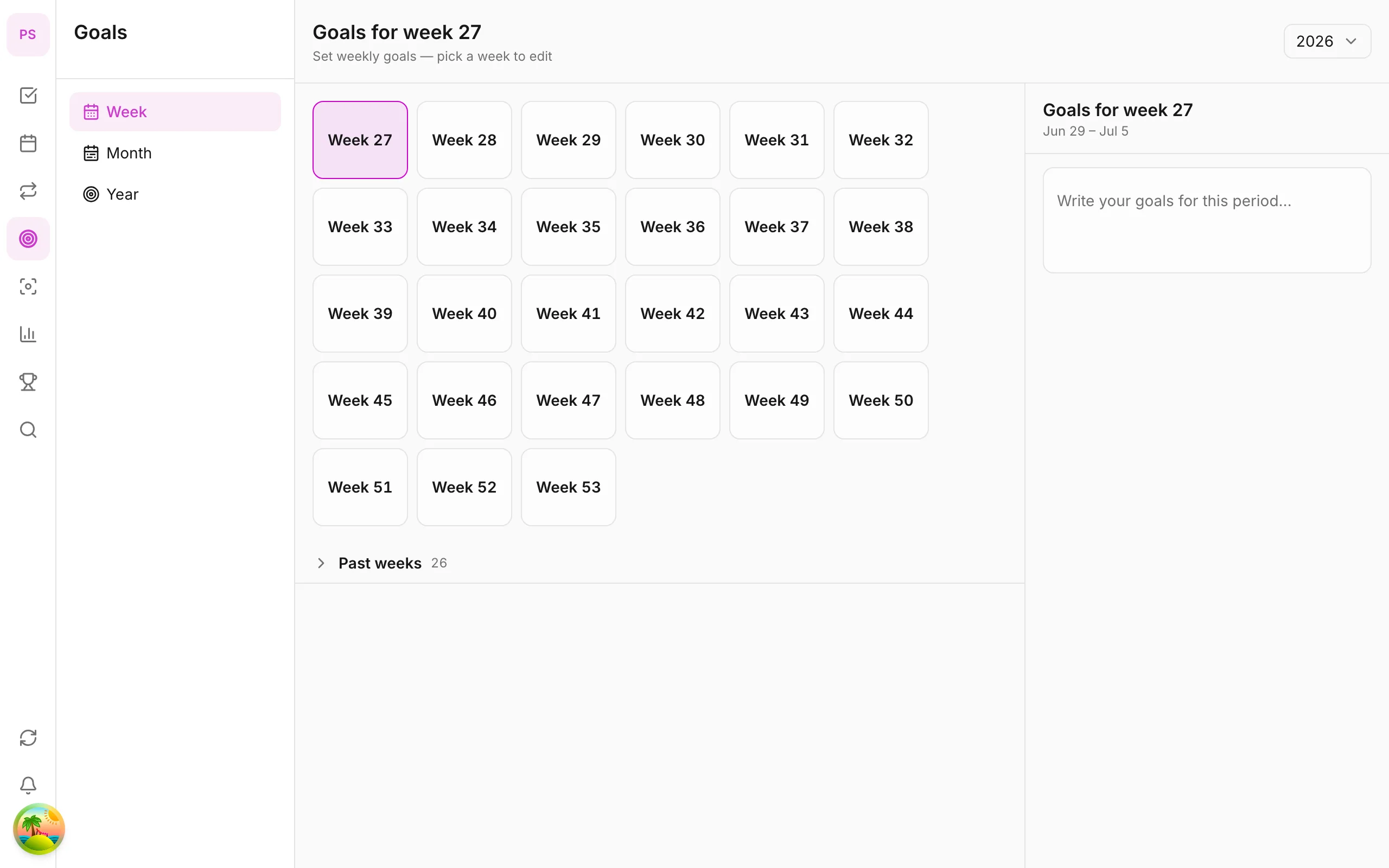
DonDon has goals at three horizons next to your tasks and habits:
- Week goals are on the Free plan.
- Month and year goals are Premium ($1.99/month or $11.99/year).
- Tasks and habits sit in the same workspace, so you can see what supports each goal.
- Statistics and achievements show progress and streaks.
See the goals guide and habit tracker guide.
A worked example
Yearly: run a half marathon in October. Month (March): run 15 km in one go. Week: three runs, one long. Habit: put on running shoes before breakfast on run days (see habit stacking examples). Tasks: book a race, find a training plan, buy shoes.
Writing goals you can actually evaluate
A goal you cannot evaluate is a wish. Test each one with four questions:
- Specific. Would a stranger know what "done" looks like?
- Measurable. Is there a number, date or yes/no outcome?
- Within your control. Does success depend mostly on your actions?
- Time-bound. Does it have a deadline, even a soft one?
Compare:
| Weak | Stronger |
|---|---|
| Get fit | Run 10 km without stopping by 30 June |
| Learn Spanish | Complete 100 lessons and hold a 10-minute conversation by December |
| Grow my business | Sign 5 new clients by the end of Q2 |
| Save money | Save $3,000 by 31 December |
| Be less stressed | Do a 10-minute walk after lunch 5 days a week |
Outcome goals, process goals and habits
Mix three kinds:
- Outcome goals describe a result ("publish the book"). They motivate but are partly outside your control.
- Process goals describe actions you control ("write 500 words, five days a week").
- Habits are the repeated behaviours that deliver the process.
If you only set outcome goals, you will not know what to do on Tuesday. If you only set process goals, you may forget why. Use both.
Balancing the horizons
A common mistake is making every horizon about work. Include areas such as:
- Health and energy
- Relationships
- Money
- Learning
- Work or business
- Rest and enjoyment
You do not need a goal in each area every year, but if one area has had none for a long time, ask why.
Handling goals that stall
Goals stall for predictable reasons. Diagnose before you quit:
- Too big. Break into months and weeks.
- Unclear next step. Write the first physical action.
- Not important anymore. Drop it consciously. This is allowed.
- No time allocated. Schedule it on the calendar.
- Wrong environment. Change the cue, not your willpower.
A quarterly checkpoint
Every three months, spend 30 minutes asking:
- Which goals are on track?
- Which are behind, and is it because of effort, scope or relevance?
- What would I do differently if I started again today?
- What should I add, change or remove?
Write the answers somewhere you will see them. Resetting goals is a skill, not a failure.
Tools and setup
You can keep goals in any app or on paper. What matters is that goals sit near your daily list and your review routine:
- Review them in your weekly review.
- Schedule the work with time blocking.
- Back them with a habit; see habit stacking examples.
In DonDon, week goals are on the Free plan and month and year goals are Premium, so you can start with a weekly goal and add the longer horizons when you are ready.
Try it
Set one yearly goal tonight and this week's first goal. Start free on the pricing page.
Frequently asked questions
- How many goals should I have?
- Two or three per period. More than that and none of them get real attention.
- What is the difference between a goal and a habit?
- A goal is an outcome you can finish (publish a book chapter). A habit is a repeated behaviour (write 200 words a day). Habits are how most goals get done.
- Are month and year goals free in DonDon?
- Week goals are on the Free plan. Month and year goals are part of Premium.
Create a free account and start managing tasks today.
Smart task management — focus on what matters.
Create free account